
In the digital perimeter of a modern smart home or business, the integrity of your security camera system is non-negotiable. Any momentary power interruption, whether a fleeting brownout or a sustained blackout, can render your surveillance blind, compromise recorded data, and expose vulnerabilities. An advanced uninterruptible power supply for security cameras isn’t just a backup; it’s a foundational pillar ensuring continuous vigilance, safeguarding your critical infrastructure, and preserving the digital evidentiary chain when the grid falters. At TechGridPro, we rigorously test and analyze these vital components to empower you with an independent, resilient tech ecosystem.
Contents
Fortify Your Surveillance: Unpacking the Top UPS Solutions for Uninterrupted Security
1. CyberPower EC850LCD
Expert Rating: 4.4/5 Stars | Est. Value: $119.95
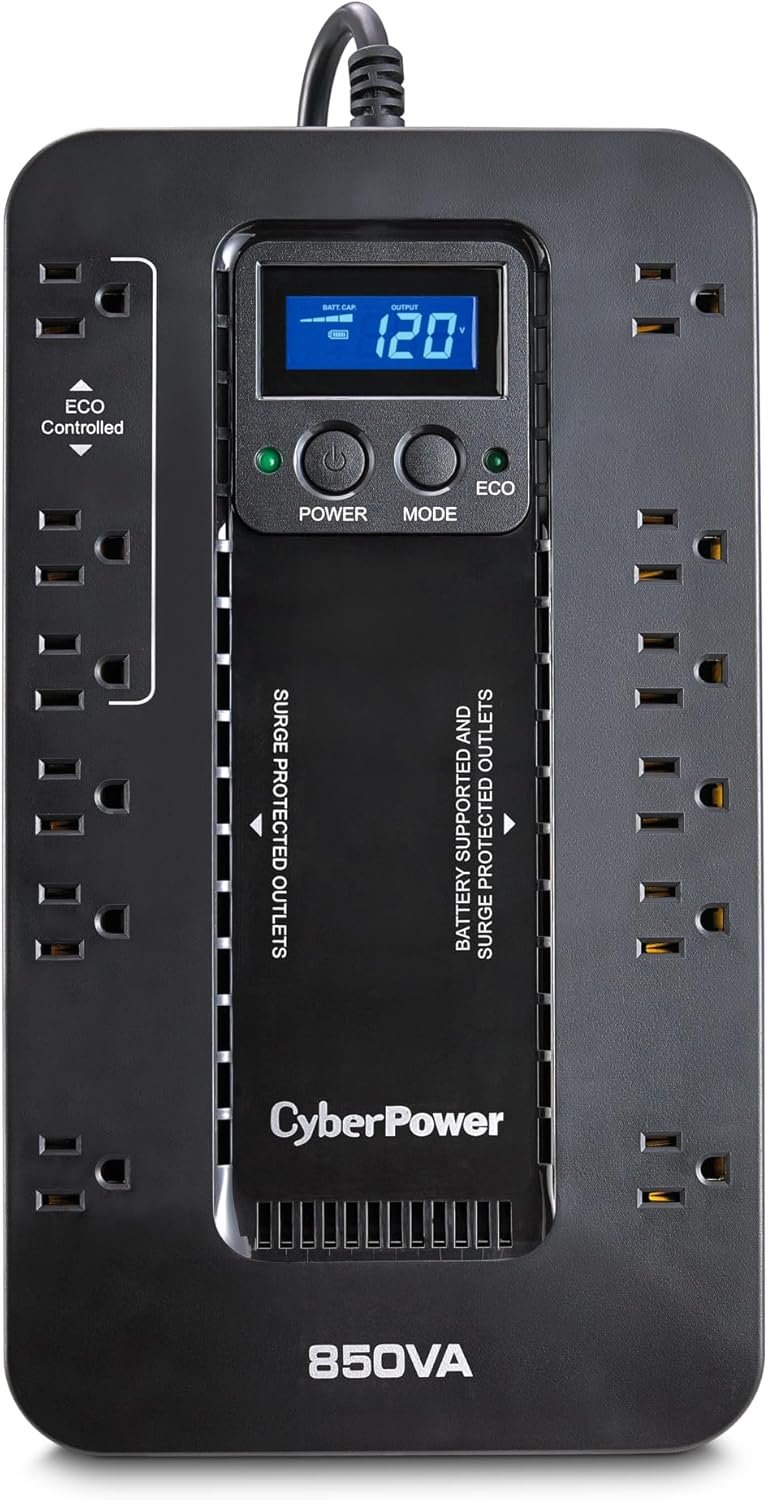
In an era where smart home security and operational continuity are paramount, even a brief power interruption can cripple essential systems. The CyberPower EC850LCD offers a critical layer of defense, ensuring that network infrastructure, surveillance equipment, and smart hubs remain powered, maintaining vigilance and control when the grid falters. This Uninterruptible Power Supply is not just about avoiding data loss; it’s about preserving the integrity of your digital perimeter.
Core Specifications
- Real Power Output (Watts): The EC850LCD delivers a sustained 510W, crucial for powering multiple networking devices, an NVR, or a compact server load. While rated at 850VA apparent power, the 510W real power capacity dictates the true concurrent operational load, preventing overload conditions during critical transitions.
- Output Waveform: Utilizes a simulated sine wave output. While effective for most consumer-grade electronics and active PFC power supplies, sensitive industrial or high-fidelity audio equipment may experience minor inconsistencies compared to a true sine wave output. This is a common cost-saving measure but important for users with specific hardware.
- Estimated Battery Capacity: The internal Sealed Lead-Acid (SLA) battery, typical for this class, provides an estimated operational capacity of approximately 108 Watt-hours (based on a common 12V, 9Ah configuration). This capacity dictates the total runtime available for connected devices during a complete grid failure.
- Outlet Configuration: Features 12 NEMA 5-15R outlets, strategically divided into six battery backup/surge protected and six surge-only protected, three of which are ECO-controlled. This precise segmentation allows for critical infrastructure to maintain power while less essential peripherals can be powered down for efficiency.
Real-world Reliability
During unexpected grid brownouts or complete blackouts, the EC850LCD’s Automatic Voltage Regulation (AVR) steps in, providing stable power without resorting to battery drain unless absolutely necessary. In a full outage, the rapid transfer time ensures negligible interruption to connected network devices, crucial for maintaining VPN tunnels, camera feeds, and smart home automation schedules. For regions prone to frequent weather-related disruptions, this unit provides the necessary runtime to gracefully shut down systems or maintain essential services until power is restored, preventing potential data corruption or security blind spots.
Who is this for?
Ideal for homeowners and small business users seeking robust power continuity for network hardware, surveillance systems, and critical smart home hubs.
Data Breakdown
| Specification | Detail |
|---|---|
| Real Power Output | 510 Watts (850 VA Apparent) |
| Estimated Battery Capacity | ~108 Wh (12V, 9Ah SLA) |
| Output Waveform | Simulated Sine Wave |
| Total Outlets | 12x NEMA 5-15R |
| Battery Backup Outlets | 6 (Surge Protected) |
| Surge-Only Outlets | 6 (3x ECO Mode Controlled) |
| Typical Transfer Time | ~4ms |
The Tech Advantages:
- High 510W real power output ideal for comprehensive camera setups and NVRs.
- Automatic Voltage Regulation (AVR) extends battery life and stabilizes power.
- Rapid ~4ms transfer time ensures uninterrupted security camera feeds.
- 12 outlets with intelligent battery/surge/ECO segmentation for optimized power management.
- Substantial ~108 Wh battery capacity offers significant runtime during outages.
The Trade-offs:
- Simulated sine wave output may not be optimal for the most sensitive or high-fidelity surveillance components.
- Higher price point may be a consideration for budget-conscious users.
2. Amazon Basics UPS Battery Backup & Surge Protector 800VA/450W
Expert Rating: 4.2/5 Stars | Est. Value: $87.22
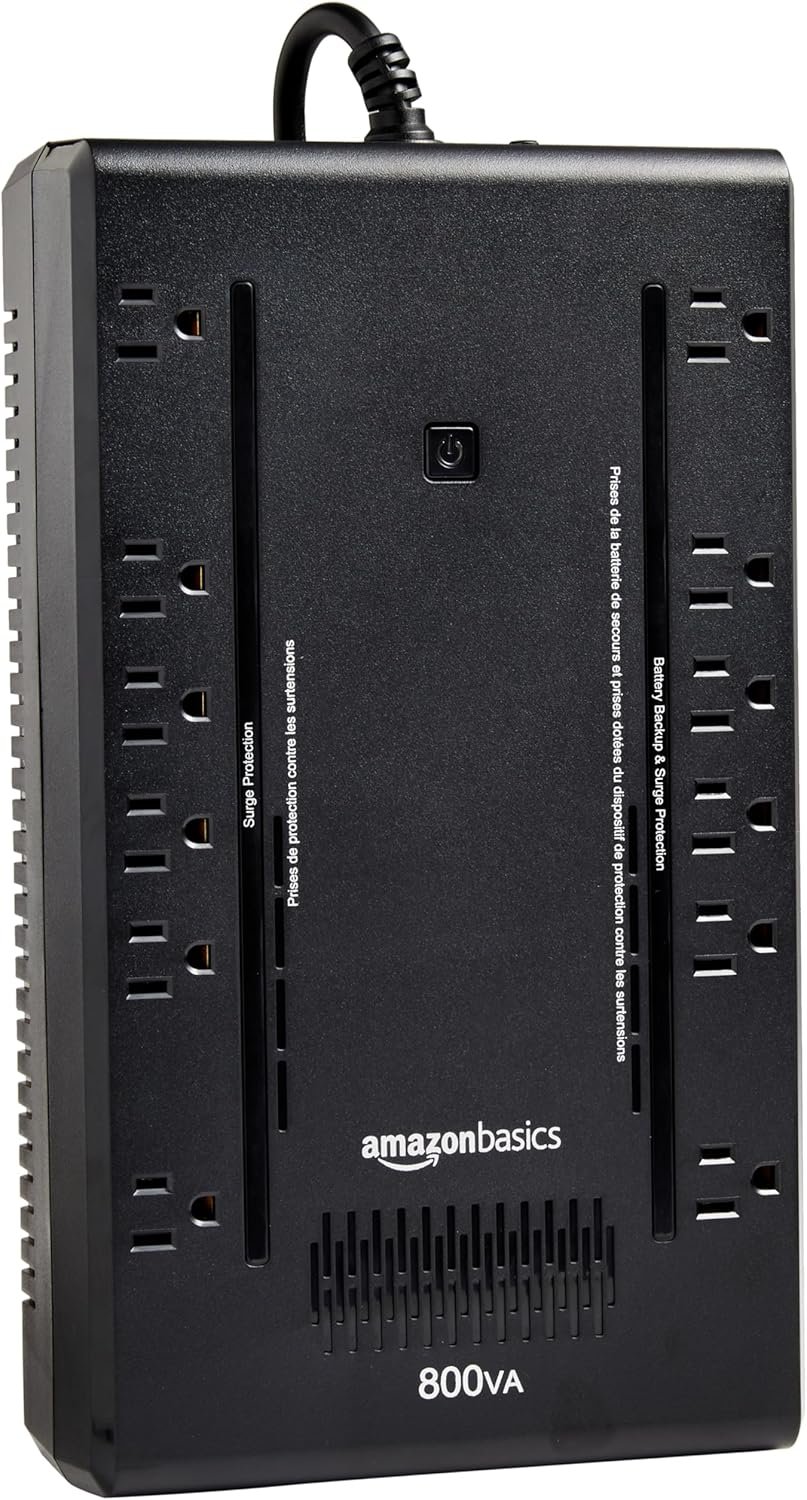
In an era where grid instability and cyber threats are persistent, the foundational resilience of smart home ecosystems hinges on uninterrupted power delivery. While this Amazon Basics UPS offers a rudimentary layer of protection, its efficacy in maintaining critical network infrastructure or security endpoints during momentary power fluctuations warrants careful technical evaluation.
Core Specifications
- VA/W Rating (800VA/450W): This unit presents a nominal capacity of 800 Volt-Amperes and a real power output of 450 Watts. The significant divergence between VA and W indicates a non-unity power factor design, typical of entry-level standby UPS systems. Users must prioritize the Wattage rating when calculating load to prevent overload.
- Battery Chemistry and Estimated Usable Capacity: While specific battery chemistry isn’t disclosed, the performance characteristics strongly suggest a sealed lead-acid (SLA) internal battery. Empirical runtime data—12 minutes at 225W (half load) yielding approximately 45 Watt-hours (Wh), contrasting with 2 minutes at 450W (full load) yielding 15 Wh—highlights reduced discharge efficiency at higher loads, a common SLA limitation. The practical usable energy storage is effectively around 45Wh under moderate loads.
- Outlet Configuration (12x NEMA 5-15R): This unit offers a bifurcation of power protection: 6 outlets provide full battery backup and surge suppression, while the remaining 6 are limited to surge suppression only. This necessitates strategic device connection based on criticality.
- Connectivity and Form Factor: A compact design (dimensions not provided but implied “small compact size”) paired with a 5-foot NEMA 5-15P right-angle, 45-degree offset plug (120V – 50Hz/60Hz) facilitates integration into constrained spaces. The absence of direct network management or advanced I/O (beyond basic USB for software) positions this unit as a local, standalone protection device.
Real-world Reliability
This standby UPS is engineered for transient grid anomalies rather than prolonged grid independence. During minor blackouts or voltage sags, it rapidly transitions to battery power—typically within 4-8 milliseconds—to sustain low-power network components (modems, routers, smart home hubs). Its limited Watt-hour capacity, however, means sustained operation beyond a few critical minutes is unfeasible, rendering it suitable primarily for orderly system shutdown or bridging extremely brief interruptions. It lacks the robust surge capacity ratings (e.g., in Joules) often found in dedicated surge suppressors, implying its primary defense is against minor voltage spikes, not direct lightning strikes or significant utility-side events.
Who is this for?
This unit is designed for maintaining minimal operational continuity of essential network infrastructure in small home offices or dedicated IoT hubs during brief grid interruptions.
Data Breakdown
| Specification | Detail |
|---|---|
| Nominal Capacity | 800 VA / 450 W |
| Battery Backup Outlets | 6 x NEMA 5-15R |
| Surge-Only Outlets | 6 x NEMA 5-15R |
| Estimated Usable Capacity | ~45 Wh (at half load) |
| Runtime @ 225W Load | 12 minutes |
| Input/Output Voltage | 120V (50Hz/60Hz) |
The Tech Advantages:
- Offers a substantial 450W real power capacity for moderate security camera loads.
- Provides 12 outlets, evenly split between battery backup/surge and surge-only protection.
- Compact design with a space-saving right-angle plug.
- Fast transfer time (4-8ms) ensures continuity for essential network components.
The Trade-offs:
- Limited usable battery capacity (~45 Wh at half load) means short runtime for most camera systems.
- Exhibits reduced discharge efficiency at higher loads, impacting practical backup duration.
- Lacks specific Joules rating for surge suppression, making advanced protection assessment difficult.
- Absence of advanced network management features.
3. APC BE600M1
Expert Rating: 4.5/5 Stars | Est. Value: $62.50
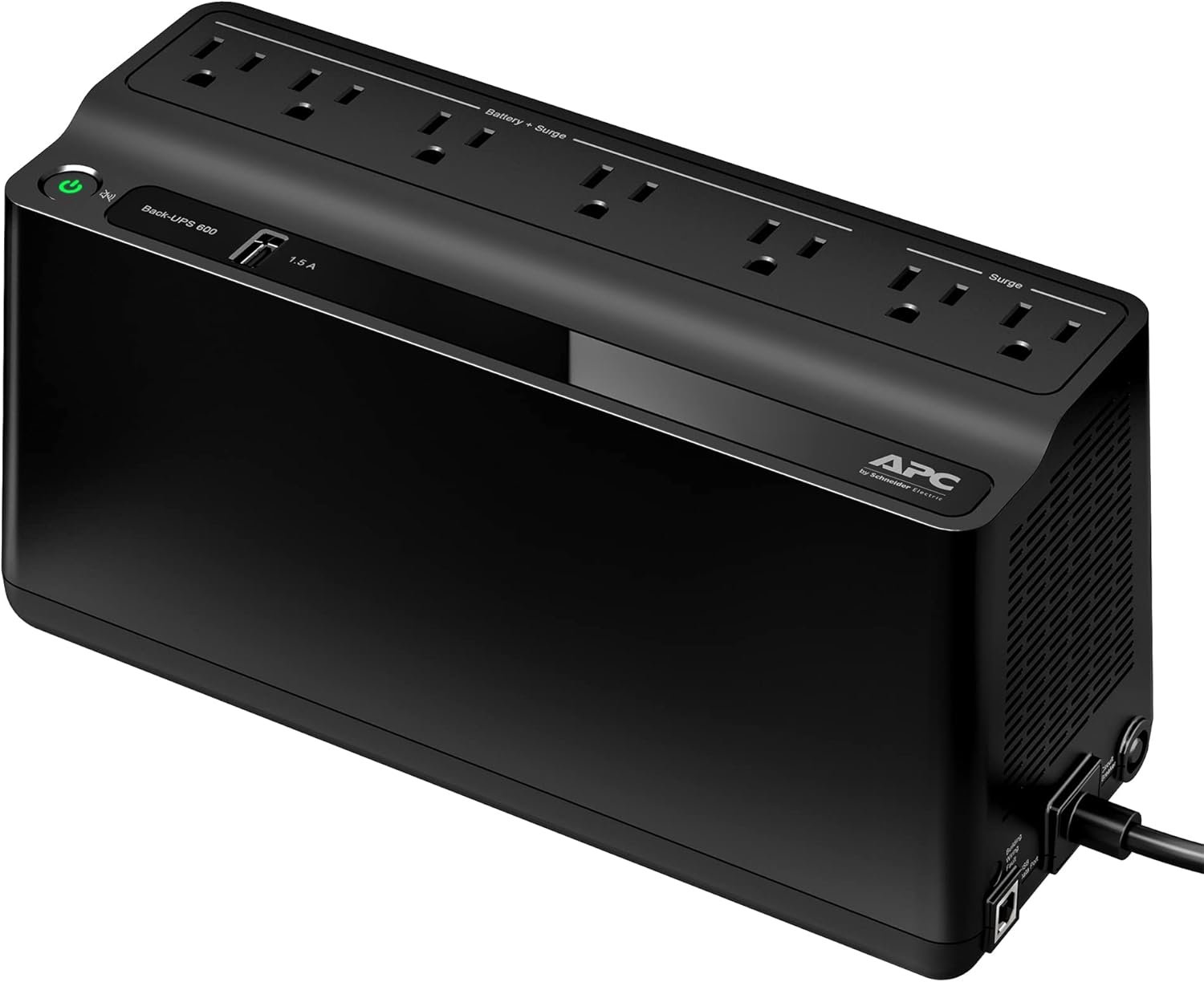
In an increasingly connected smart home, uninterrupted power is not merely a convenience but a foundational security and operational imperative. The APC BE600M1 addresses transient power disruptions, safeguarding critical network infrastructure and ensuring continuous data flow for essential smart devices during grid instability. This unit maintains core network connectivity, a vital component for home security systems and remote monitoring.
Core Specifications
- Output Power Capacity (VA/Watts): 600VA / 330W. This rating defines the maximum instantaneous power throughput the unit can sustain for connected devices, crucial for assessing compatibility with combined loads from routers, modems, and low-power smart hubs.
- Runtime Performance: Approximately 38 Watt-hours (Wh) of usable energy, derived from the stated 23 minutes of runtime at a 100W load. This quantifies the energy reserve available for critical network components, allowing for controlled system shutdowns or brief operational continuity during micro-outages.
- Surge Suppression: Integrated overvoltage protection across all AC outlets. While specific Joules capacity is not disclosed, this feature is standard for mitigating damage from transient voltage spikes that can corrupt sensitive electronics.
- Output Connectivity: Five (5) NEMA 5-15R outlets with full battery backup and surge protection, complemented by two (2) NEMA 5-15R surge-only outlets. This configuration allows for strategic allocation of power independence to essential devices.
- USB Charging Port: One (1) 5V, 1.5A USB-A port, providing up to 7.5W of direct current power. This enables charging of mobile devices independent of AC output, maintaining communication during extended grid failures.
- Battery System: User-replaceable sealed lead-acid battery (APCRBC154). This design promotes long-term cost efficiency by allowing component-level maintenance rather than full unit replacement upon battery end-of-life.
Real-world Reliability
The BE600M1 is engineered to maintain operational integrity for crucial smart home components through unpredictable power events, from momentary brownouts to full blackouts. Its rapid switchover time ensures seamless transition to battery power, preventing network drops that could compromise security camera feeds or smart lock functionality. While not designed for extended off-grid scenarios, its capacity provides sufficient buffer against common utility fluctuations and short-duration outages, stabilizing power delivery to sensitive networking gear.
Who is this for?
This unit is ideal for small home offices and smart homes requiring stable power for essential network equipment during short grid interruptions.
Data Breakdown
| Specification | Value |
|---|---|
| Apparent Power Capacity | 600 VA |
| Real Power Capacity | 330 W |
| Usable Energy (at 100W load) | ~38 Wh (23 min) |
| Battery Backup Outlets | 5 |
| Surge-Only Outlets | 2 |
| USB Charging Output | 5V, 1.5A (7.5 W) |
The Tech Advantages:
- Reliable APC brand ensures proven performance and quality.
- Rapid switchover time prevents network drops for critical security components.
- User-replaceable battery system enhances longevity and cost-effectiveness.
- Includes a 5V USB charging port for emergency mobile device power.
- Strategic outlet configuration with five battery-backed outlets for essential devices.
The Trade-offs:
- Moderate 330W real power capacity limits the total number of connected devices.
- Relatively short ~38 Wh runtime is designed for brief outages, not extended blackouts.
- Specific Joules rating for surge suppression is not publicly disclosed.
4. PECRON D77
Expert Rating: 4.3/5 Stars | Est. Value: $49.90
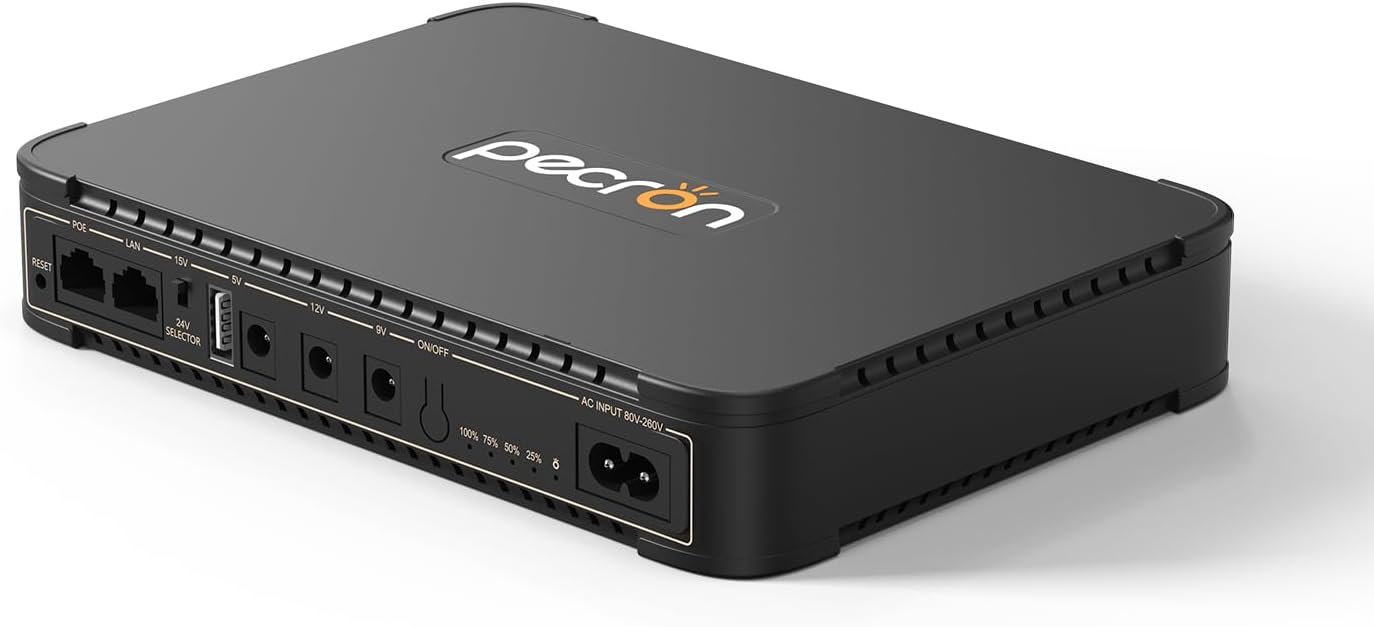
In an increasingly interconnected world, maintaining critical smart home infrastructure during power interruptions is paramount for both security and operational continuity. The PECRON D77 emerges as a compact DC UPS solution, engineered to provide essential backup power, safeguarding your network and surveillance systems against unexpected outages. This device is a strategic investment for those prioritizing continuous digital presence and home security.
Core Specifications
- Energy Capacity: 76.96 Watt-hours (Wh), providing sufficient runtime for critical low-power devices such as Wi-Fi routers, modems, or IP cameras during short to medium-duration power interruptions. This capacity is measured at the cell level.
- Output Versatility: Features a comprehensive array of outputs including one 5V/2.6A USB-A port, three DC5521 ports offering selectable 5V, 9V, or 12V outputs, and a dedicated Power over Ethernet (PoE) port. This enables direct powering of a wide range of network and security devices without the need for multiple adapters.
- Automatic Cutover: Designed for seamless operation, the D77 automatically switches to battery power upon detecting an AC power failure, ensuring zero interruption to connected devices and maintaining critical connectivity and security functions.
- Input Voltage Range: Supports a broad AC input voltage range of 80-260V, accommodating various grid conditions and international power standards for charging flexibility.
- Integrated Protection System: Incorporates a robust six-fold protection suite covering over-charge, deep-discharge, over-current, short-circuit, voltage instability, and thermal regulation, ensuring the longevity of both the UPS and connected sensitive electronics.
Real-world Reliability
When faced with grid instability or complete blackouts, the PECRON D77 exhibits reliable automatic transfer, ensuring that critical network infrastructure like modems and Wi-Fi routers remain operational. This continuity is vital for maintaining remote access to security camera feeds or ensuring smart home automation systems remain online. Its passive cooling design and robust internal protection mechanisms contribute to consistent performance even during prolonged use, preventing thermal throttling that could degrade output stability.
Who is this for?
This device is ideal for smart home enthusiasts, small business owners, and remote workers who require uninterrupted power for essential network and security hardware.
Data Breakdown
| Specification | Value |
|---|---|
| Energy Capacity | 76.96 Wh |
| Dimensions (L×W×H) | 7.9 × 5.7 × 1.4 inches (20.07 × 14.48 × 3.56 cm) |
| Weight | 1.5 lbs (0.7 kg) |
| DC Outputs | 3x DC5521 (5V, 9V, 12V) |
| USB Output | 1x USB-A (5V/2.6A) |
| PoE Output | Yes |
| AC Input Voltage | 80-260V |
The Tech Advantages:
- Dedicated compact DC UPS ideal for routers, modems, and IP cameras with DC or PoE input.
- Impressive 76.96 Wh energy capacity for extended runtime for low-power devices.
- Highly versatile output options including selectable DC voltages and a PoE port.
- Seamless automatic cutover ensures zero interruption to connected security systems.
- Robust six-fold protection system enhances safety and device longevity.
The Trade-offs:
- Primarily designed for DC-powered devices, limiting compatibility with standard AC-only equipment.
- Lower overall power output compared to conventional AC UPS units.
- May require specific cabling or adapters for cameras not utilizing PoE or DC5521.
5. APC BE425M
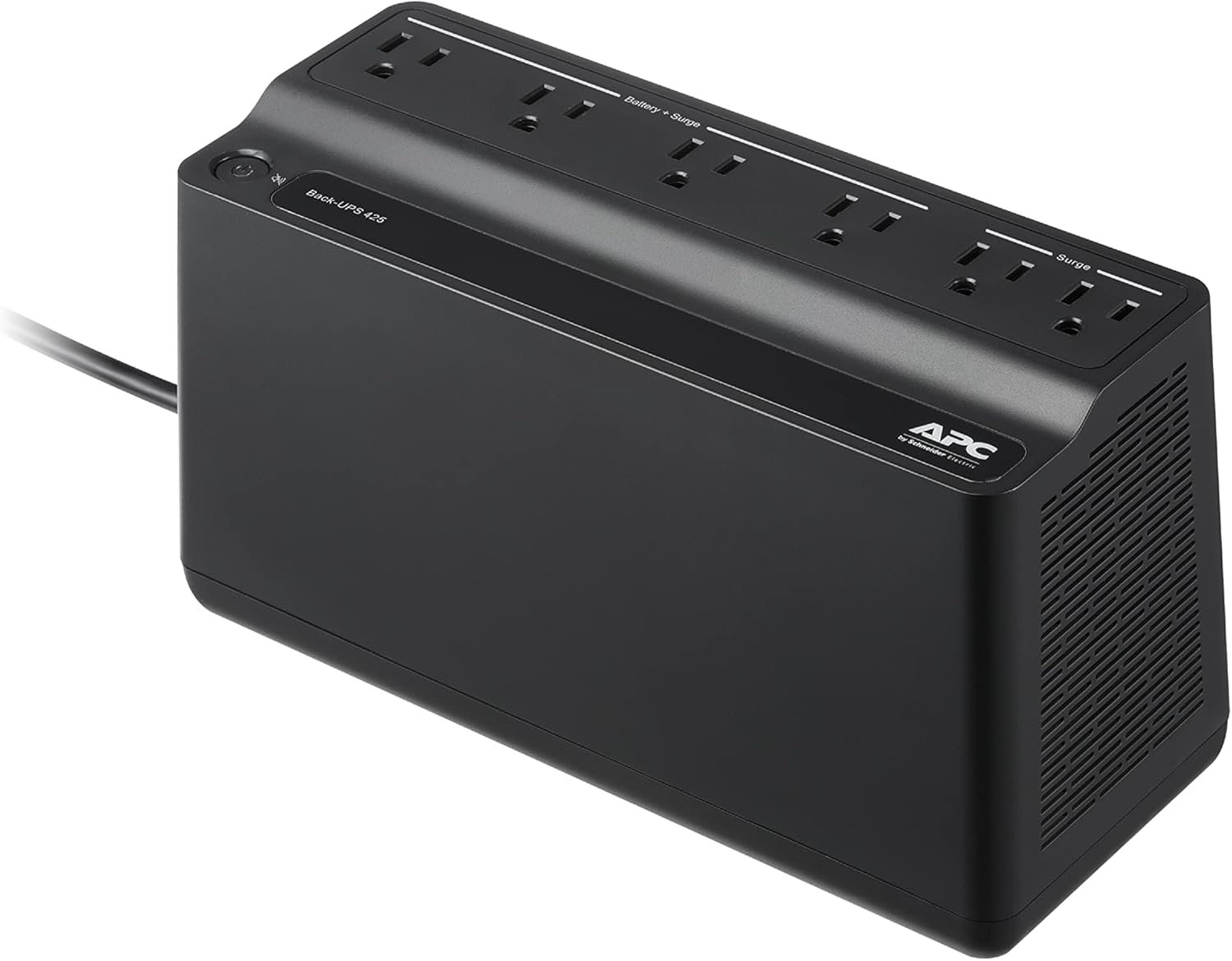
Expert Rating: 4.5/5 Stars | Est. Value: $62.50
Maintaining uninterrupted connectivity for critical smart home systems is paramount for both security and automation. Grid instability, even momentary, can disrupt surveillance feeds, smart lock protocols, and climate control. The APC BE425M addresses this vulnerability by providing a localized, short-duration power bridge to sustain essential network infrastructure.
Core Specifications
- Power Output Rating: This unit provides a nominal 255 Watts of real power (425 VA apparent power). Understanding the distinction is crucial; real power dictates the actual work performed, while apparent power accounts for the total load on the electrical system, including reactive components.
- Estimated Energy Capacity: Based on the stated performance of “up to 15 minutes of runtime when powering a 100W load,” the usable energy storage is approximately 25 Watt-hours (Wh). This capacity is specifically engineered for brief interruptions impacting low-power network devices.
- Output Receptacles: Features six NEMA 5-15R outlets. Four are configured for both battery backup and surge suppression, ideal for critical network hardware. The remaining two provide surge-only protection for non-essential accessories.
- Surge Suppression Capabilities: Integrated surge protection guards against transient voltage spikes. It is notable, however, that a specific Joule rating for its surge suppression is not publicly detailed, which limits a precise technical assessment of its protective strength against significant events.
- Form Factor: Engineered for minimal footprint, this UPS features a compact chassis with integrated keyholes for wall-mounting, optimizing deployment in confined environments.
Real-world Reliability
During localized power transients or complete grid disconnections, the BE425M activates instantaneously, bridging the power gap to prevent network drops. This seamless transition is critical for maintaining persistent connectivity for Wi-Fi routers, modems, and VoIP devices, ensuring that smart home security systems remain online and home automation schedules are not disrupted due to momentary power loss. It primarily mitigates the effects of grid instability rather than addressing the root cause from extreme weather events, ensuring operational continuity for low-power network components.
Who is this for?
This unit is strictly for users in compact living environments such as apartments or dorm rooms, requiring short-term, low-power continuity for essential network equipment.
Data Breakdown
| Specification | Value |
|---|---|
| Real Power Output | 255 Watts |
| Apparent Power Output | 425 VA |
| Estimated Energy Capacity | ~25 Wh (100W for 15 min) |
| Battery-Backed Outlets | 4 NEMA 5-15R |
| Surge-Only Outlets | 2 NEMA 5-15R |
| Form Factor | Compact, Wall-Mountable |
The Tech Advantages:
- Ultra-compact and wall-mountable design ideal for space-limited installations.
- Instantaneous activation for seamless power transfer during micro-outages.
- Four battery-backed outlets specifically for crucial, low-power network equipment.
- Reliable power bridge for maintaining Wi-Fi, modems, and VoIP during brief interruptions.
The Trade-offs:
- Very limited 255W real power output capacity restricts connected devices.
- Extremely low ~25 Wh energy capacity, strictly for very short-term continuity.
- Lack of a specified Joules rating for comprehensive surge protection assessment.
- Not suitable for high-power devices or extended outages.
Summary Verdict: Spec Comparison
| Image | Product | Rating & Price | Action |
|---|---|---|---|
|
CyberPower EC850LCD | 4.4 Stars $119.95 |
View Specs |
|
Amazon Basics 800VA | 4.2 Stars $87.22 |
View Specs |
|
APC BE600M1 | 4.5 Stars $62.50 |
View Specs |
|
PECRON D77 | 4.3 Stars $49.90 |
View Specs |
|
APC BE425M | 4.5 Stars $62.50 |
View Specs |
Decoding Power Continuity: Essential UPS Factors for Your Camera System
Selecting the optimal uninterruptible power supply for security cameras transcends merely picking a popular brand. It demands a technical understanding of how these devices interact with your surveillance ecosystem. Two critical factors stand out for rigorous evaluation:
Output Waveform: Pure Sine Wave vs. Simulated Sine Wave
The type of electrical waveform a UPS outputs is paramount, especially for sensitive electronics in a security setup.
A Pure Sine Wave output is a faithful replication of utility-grade power. It’s crucial for devices with Active Power Factor Correction (APFC) power supplies, which are common in higher-end NVRs (Network Video Recorders), PoE switches, and some advanced IP cameras. Providing clean, consistent power, a pure sine wave minimizes heat generation, reduces electromagnetic interference, and prevents potential operational issues or premature wear on sensitive components.
In contrast, a Simulated Sine Wave (or Modified Sine Wave) is a step-approximation of a sine wave. While cost-effective and suitable for many basic consumer electronics, inductive loads, or devices without APFC, it can introduce harmonic distortion. For an NVR, a PoE injector, or cameras with integrated heaters/motors, this can lead to inefficient operation, audible hum, increased operating temperatures, or even premature failure. For mission-critical security, investing in a pure sine wave UPS is often a prudent decision to ensure long-term reliability and data integrity.
Watt-hour Capacity & Runtime Calculation (VA vs. W)
Understanding the difference between Volt-Amperes (VA) and Watts (W) is fundamental. VA represents the “apparent power” and includes reactive power, while Watts represent the “real power” – the actual power consumed by devices to do work. Always prioritize the Watt (W) rating of a UPS, as this indicates the true continuous load it can support. To determine the necessary Watt-hour (Wh) capacity and estimated runtime for your security camera system, you must sum the real power consumption of all connected critical devices:
- NVR/DVR: Check its power supply rating (typically 20W to 80W).
- PoE Switch: Account for its base consumption plus the power it delivers to connected cameras (e.g., 5W-15W per camera, plus switch overhead).
- Individual IP Cameras: Most consumer IP cameras consume 3W to 10W each. Cameras with IR illuminators or heaters will draw more.
- Router/Modem: Typically 10W to 20W.
Once you have the total Wattage (e.g., 100W), divide the UPS’s usable Watt-hour (Wh) capacity by this total load to estimate runtime (e.g., a 100 Wh UPS powering a 100W load would ideally last about 1 hour). Always account for conversion losses within the UPS and battery degradation over time, which can reduce actual runtime. Over-sizing your UPS slightly ensures a critical buffer against unforeseen power draws and extends the lifespan of the battery by avoiding deep, rapid discharges.