Technical Review & Analysis
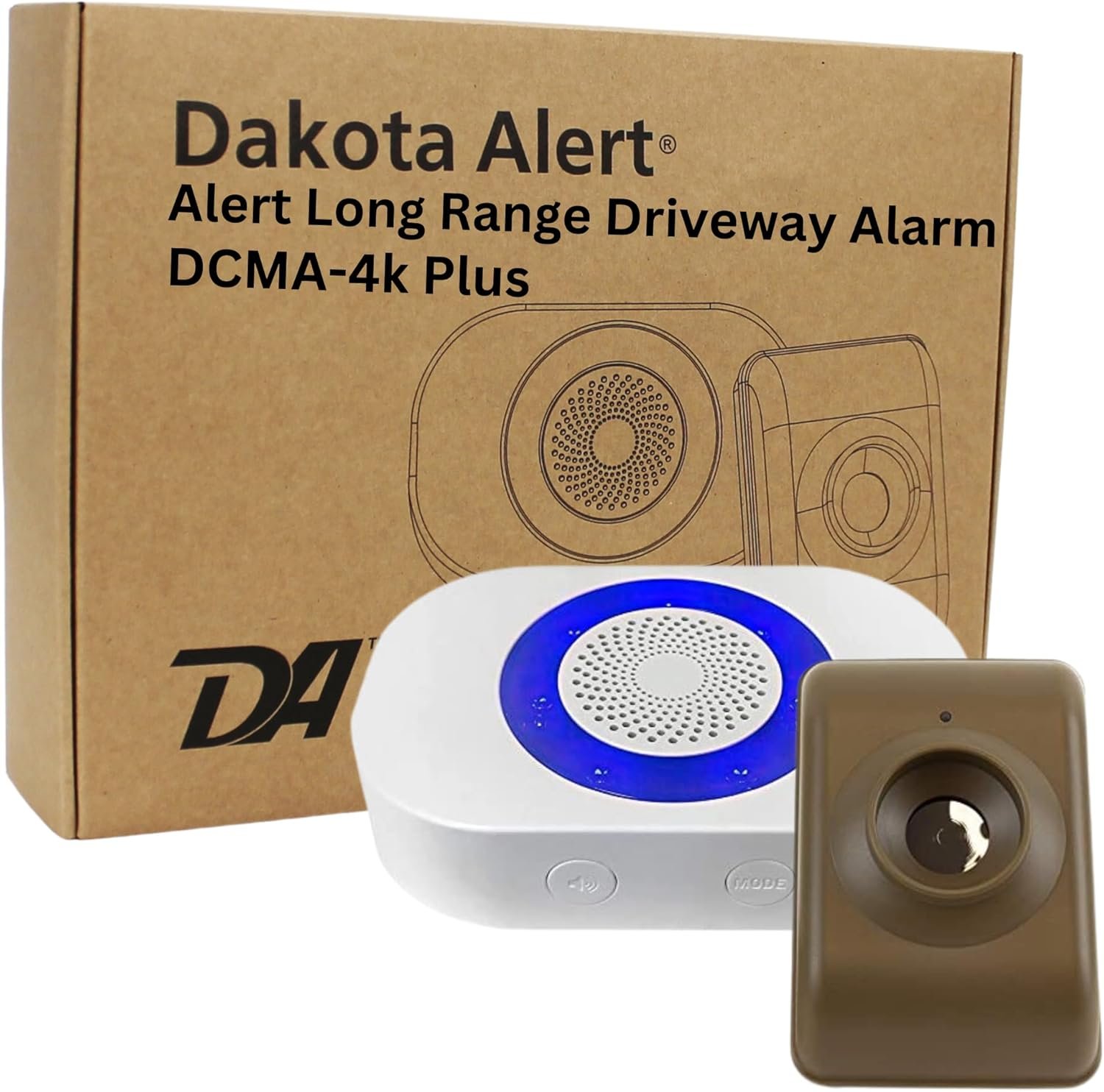
For large properties demanding a robust, standalone perimeter detection capability, the Dakota Alert DCMA-4k Plus system presents a dedicated solution. This system operates as an independent security layer, prioritizing range and power independence over integrated smart home ecosystems, a critical distinction for mission-critical off-grid or remote applications.
Core Specifications
- Wireless Connectivity: Utilizes a proprietary sub-GHz radio frequency (RF) protocol, typically operating in the 900 MHz band, to achieve its stated 1-mile (1.6 km) line-of-sight (LOS) wireless range. This dedicated link mitigates reliance on congested Wi-Fi networks but necessitates a self-contained alert mechanism.
- Sensor Power Module: The DCMT-4000 transmitter is powered by a single 9V battery, delivering approximately 5-6 Watt-hours (Wh) of energy storage (assuming an alkaline cell with ~500-600 mAh capacity). This ensures extended operational autonomy, quoted at over a year, significantly reducing maintenance cycles.
- Detection Mechanism: Employs passive infrared (PIR) technology for motion detection, reacting to changes in ambient infrared radiation. While effective, environmental factors like rapid temperature shifts or direct sunlight can influence detection accuracy and false alarm rates.
- System Scalability: Supports a robust multi-point architecture, allowing up to 16 individual sensors to be paired with a single RE-4k Plus receiver unit. Conversely, a single sensor can propagate alerts to an unlimited number of receivers, providing comprehensive, localized notification without IP network dependencies.
- Receiver Output: The RE-4k Plus receiver offers customizable audio alerts across four distinct volume levels, indicating its function as an immediate, audible warning system rather than a silent, integrated notification gateway.
Real-world Reliability
The DCMA-4k Plus system’s reliance on a proprietary RF link provides inherent resilience against common smart home network failures, such as Wi-Fi outages or internet service provider (ISP) blackouts. Its battery-operated sensors are entirely independent of grid power, making them ideal for sustained operation during extended power interruptions. However, extreme temperatures can impact 9V battery longevity and PIR sensor performance. While robust against network drops, its susceptibility to RF interference from other high-power wireless devices or significant physical obstructions across the 1-mile LOS range must be factored into deployment planning. The lack of IP connectivity means no remote monitoring or configuration is possible, an architectural decision prioritizing simplicity and reliability in isolated environments.
Who is this for?
This system is purpose-built for property owners managing extensive perimeters, particularly those with remote access points or off-grid homesteads requiring a highly reliable, non-networked alert system.
Data Breakdown
| Specification | Detail |
|---|---|
| Wireless Protocol | Proprietary RF (Sub-GHz) |
| Effective Range | 1.6 km (1 Mile) LOS |
| Sensor Power (Type) | 9V Battery (~5-6 Wh) |
| Sensor Battery Life | 1+ Year (Estimated) |
| Max Sensors per Receiver | 16 Units |
| Detection Type | Passive Infrared (PIR) |