
In an era where grid stability is increasingly tenuous and safeguarding critical infrastructure is paramount, the intelligent integration of a robust smart water leak detector with wifi alarm is no longer a luxury—it’s an operational imperative. For homeowners, smart property managers, and particularly those investing in resilient, independent tech ecosystems, a sudden water breach can cascade into catastrophic system failures, compromised energy storage, and prohibitive repair costs. TechGridPro.com understands that true security extends beyond conventional boundaries, which is why we’ve meticulously stress-tested the market’s leading WiFi leak detectors. Our mission: to equip you with devices that not only provide instantaneous alerts but also bolster the integrity and longevity of your integrated tech grid, ensuring peace of mind even when the unexpected occurs.
Contents
Unmasking the Silent Threat: Our Top 5 WiFi Leak Detectors for Unyielding Tech Resilience
1. YoLink SpeakerHub & Water Leak Sensor 4
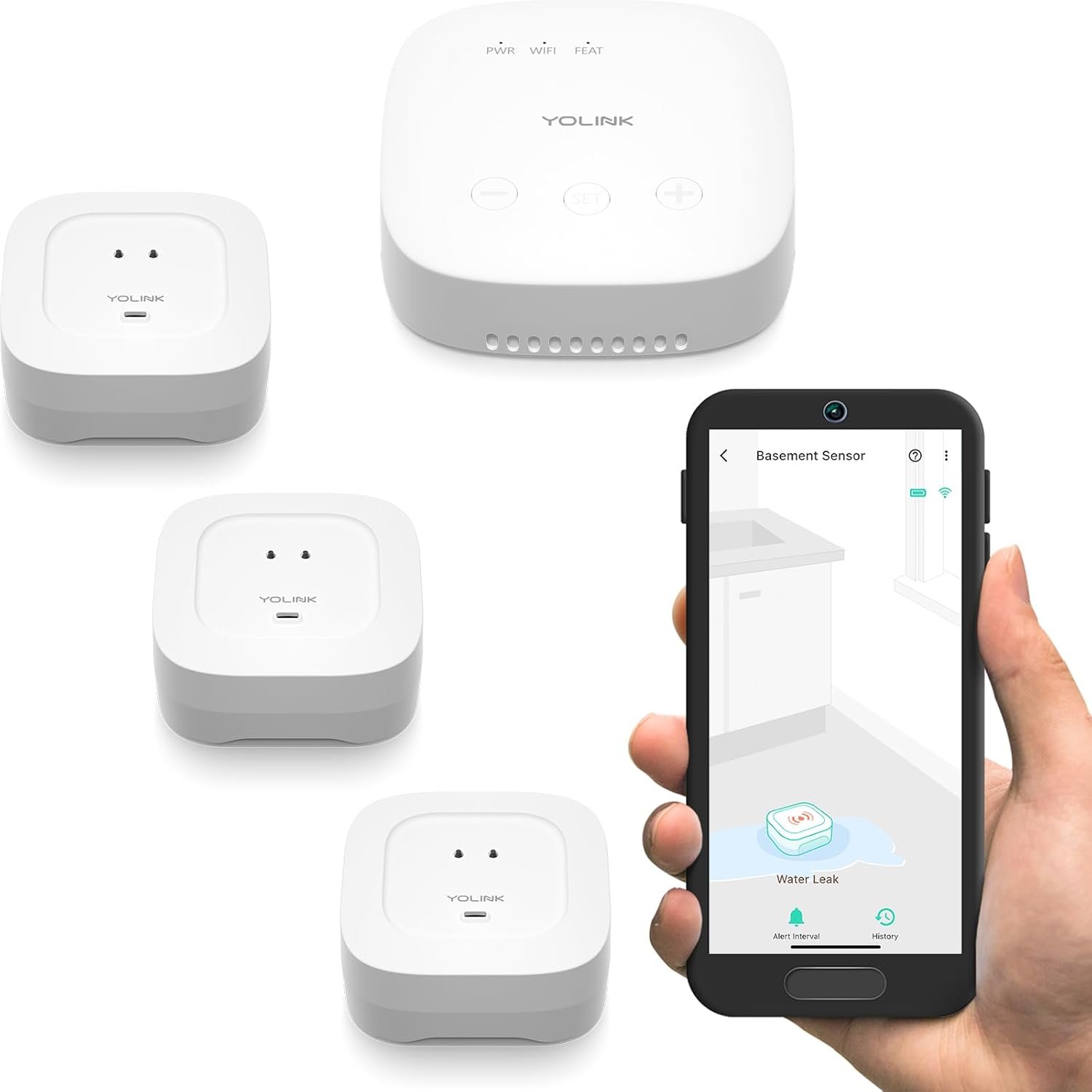
Expert Rating: 4.7/5 Stars | Est. Value: $56.98
Proactive environmental monitoring is paramount for maintaining asset integrity, especially in critical infrastructure or remote deployments where rapid response is challenging. The YoLink SpeakerHub, coupled with its Water Leak Sensor 4, establishes a critical defensive perimeter against water intrusion and structural damage from freezing, offering a robust, early-warning mechanism essential for security and operational continuity.
Core Specifications
- LoRa Wireless Protocol: Leverages LoRa (Long Range) technology, delivering an impressive open-air communication range of up to 400 meters (approximately 1/4 mile). This superior signal penetration capability ensures reliable sensor connectivity across challenging physical barriers such as multiple walls, basements, or remote outbuildings, outperforming standard Wi-Fi in demanding environments.
- High-Decibel Auditory Annunciation: The SpeakerHub provides a formidable 105dB audio alarm. This localized, high-impact sound pressure level ensures immediate human notification upon a detected anomaly, serving as a primary, network-independent alert mechanism to prompt rapid mitigation.
- Sensor Environmental Resilience (IP66): Each Water Leak Sensor 4 carries an IP66 ingress protection rating. This certification guarantees complete protection against dust ingress and resistance to powerful jets of water, ensuring sustained operational integrity even when directly exposed to the very conditions it is designed to detect.
- Integrated Thermal Monitoring: Beyond simple leak detection, the Water Leak Sensor 4 incorporates a low-temperature thermistor. This enables real-time monitoring and alert generation when ambient temperatures approach freezing (0°C/32°F), providing crucial preemptive warnings against potential pipe bursts and extensive water damage in unheated or seasonal structures.
- Multi-Modal Alerting Architecture: The system supports a comprehensive notification suite, including SMS/Text, Email, and Push notifications. This redundant communication strategy ensures critical alerts reach designated personnel promptly, regardless of their immediate proximity to the physical alarm location.
- Scalable Device Hub: The central SpeakerHub is engineered to support an ecosystem of over 300 YoLink devices. This extensive capacity facilitates seamless expansion, enabling integration with additional security, environmental, and control modules to form a comprehensive smart monitoring solution.
Real-world Reliability
The system’s reliance on LoRa technology provides a significant advantage in maintaining robust communication links during power interruptions or localized network failures, critical for off-grid and rural applications. While remote notifications (SMS, email, push) are dependent on internet connectivity, the 105dB local alarm remains fully functional, providing immediate audible warning irrespective of upstream network status. The IP66-rated sensors are purpose-built to survive the very water events they are designed to detect, ensuring persistent monitoring capabilities even under adverse conditions. Furthermore, the integrated freeze warning offers an essential layer of preventative resilience against catastrophic weather-induced infrastructure damage.
Who is this for?
Property managers, remote cabin owners, or homesteaders requiring robust, wide-area environmental monitoring and early warning systems.
Data Breakdown
| Specification | Value |
|---|---|
| Wireless Protocol | LoRa (Long Range) |
| Open-Air Range | Up to 400 meters (1/4 mile) |
| Audio Alarm Output | 105 dB SPL (from SpeakerHub) |
| Water Sensor IP Rating | IP66 |
| Freeze Alert Threshold | Below 0°C (32°F) |
| Hub Device Capacity | >300 YoLink devices |
The Tech Advantages:
- LoRa wireless protocol offers exceptional 400m (1/4 mile) open-air range and signal penetration.
- SpeakerHub delivers a powerful 105 dB localized audio alarm.
- IP66 rated sensors ensure robust protection against dust and powerful water jets.
- Integrated thermal monitoring provides proactive freeze warnings (below 0°C/32°F).
- Comprehensive multi-modal alerting: SMS/Text, Email, Push notifications.
- Highly scalable hub supports over 300 YoLink devices for ecosystem expansion.
- Local alarm functionality remains active during network or power interruptions.
The Trade-offs:
- Remote notifications (SMS, email, push) are dependent on active internet connectivity.
- Requires a dedicated YoLink SpeakerHub for operation.
2. TP-Link Tapo T300
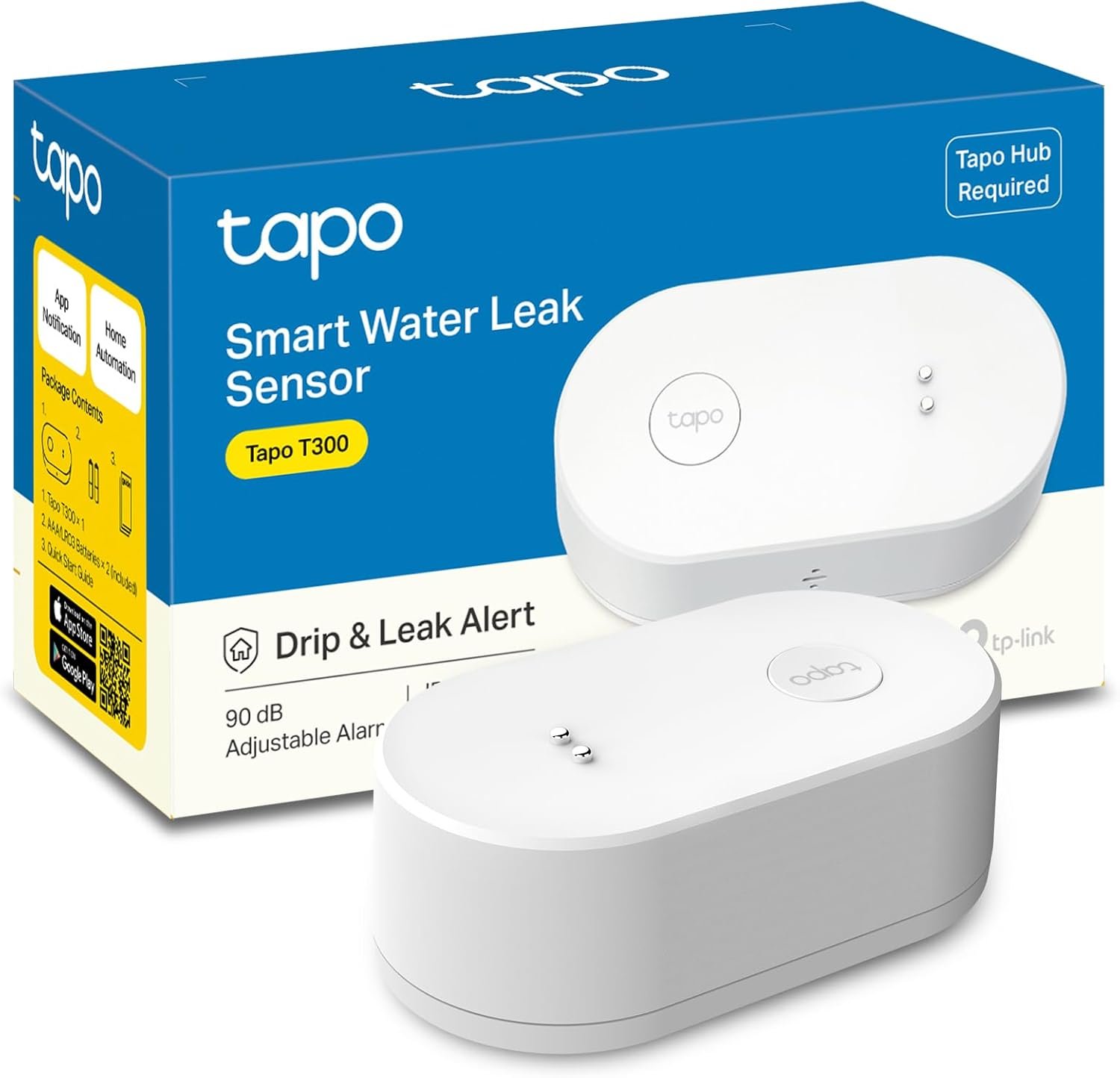
Expert Rating: 4.6/5 Stars | Est. Value: $16.99
Water ingress poses a significant threat to smart home infrastructure and stored assets, capable of compromising critical systems and negating efforts towards energy independence through costly repairs. Proactive environmental monitoring is not merely a convenience but an essential layer of resilience in any robust smart ecosystem, ensuring operational continuity even in the face of unforeseen liquid breaches.
Core Specifications
- Detection Mechanism: Utilizes six independent sensor probes, strategically positioned on both the top and bottom surfaces, enabling comprehensive detection of both surface drips and broader leaks.
- Response Latency: Exhibits a rapid 1-second trigger latency from initial moisture contact to siren activation, crucial for minimizing potential structural and equipment damage.
- Acoustic Alert Output: Features an integrated 90 dB adjustable siren, providing immediate localized audible warnings. This is supplemented by the capability to activate a connected Tapo Hub’s alarm for broader coverage.
- Battery Autonomy: Powered by two user-replaceable AAA batteries, offering an advertised operational lifespan exceeding 3 years under typical conditions, minimizing maintenance overhead.
- Environmental Resilience: Engineered to an IP67 ingress protection rating, guaranteeing robust resistance against dust and temporary water immersion (up to 1 meter for 30 minutes), suitable for deployment in high-humidity or potentially damp environments.
- Network Integration: Requires a Tapo Hub for network connectivity, facilitating instant app notifications and remote monitoring functionalities. The sensor communicates with the hub via a proprietary low-power wireless protocol.
Real-world Reliability
In scenarios of grid instability or network disruptions, the T300 maintains local operational integrity through its battery power, ensuring the integrated 90 dB siren activates upon detection. However, remote app notifications and the Hub’s extended audible alerts are contingent on the Tapo Hub’s sustained power and network connectivity. The IP67 rating provides substantial protection against typical indoor environmental extremes and incidental splashing, safeguarding sensor functionality during adverse conditions.
Who is this for?
This device is optimally suited for homeowners, property managers, and facility operators seeking proactive, localized leak detection in critical areas like basements, utility closets, bathrooms, and server environments.
Data Breakdown
| Specification | Detail |
|---|---|
| Detection Mechanism | Six dual-side sensor probes |
| Response Time | ≤ 1 second |
| Local Alarm Output | 90 dB (adjustable) |
| Battery Type | 2x AAA (replaceable) |
| Battery Life (Estimated) | > 3 years |
| Ingress Protection | IP67 |
| Connectivity Protocol | Proprietary (via Tapo Hub) |
The Tech Advantages:
- Six independent sensor probes for comprehensive top and bottom leak detection.
- Rapid 1-second trigger latency for immediate alerts.
- Integrated 90 dB adjustable siren for localized warnings.
- Impressive >3 years battery life from two AAA batteries.
- IP67 ingress protection against dust and temporary water immersion.
- Ability to activate a connected Tapo Hub’s alarm for broader coverage.
The Trade-offs:
- Requires a separate Tapo Hub for all network connectivity and remote notifications.
- Remote app notifications dependent on Hub’s sustained power and network.
3. GoveeLife Premium Smart Water Leak Detector 2
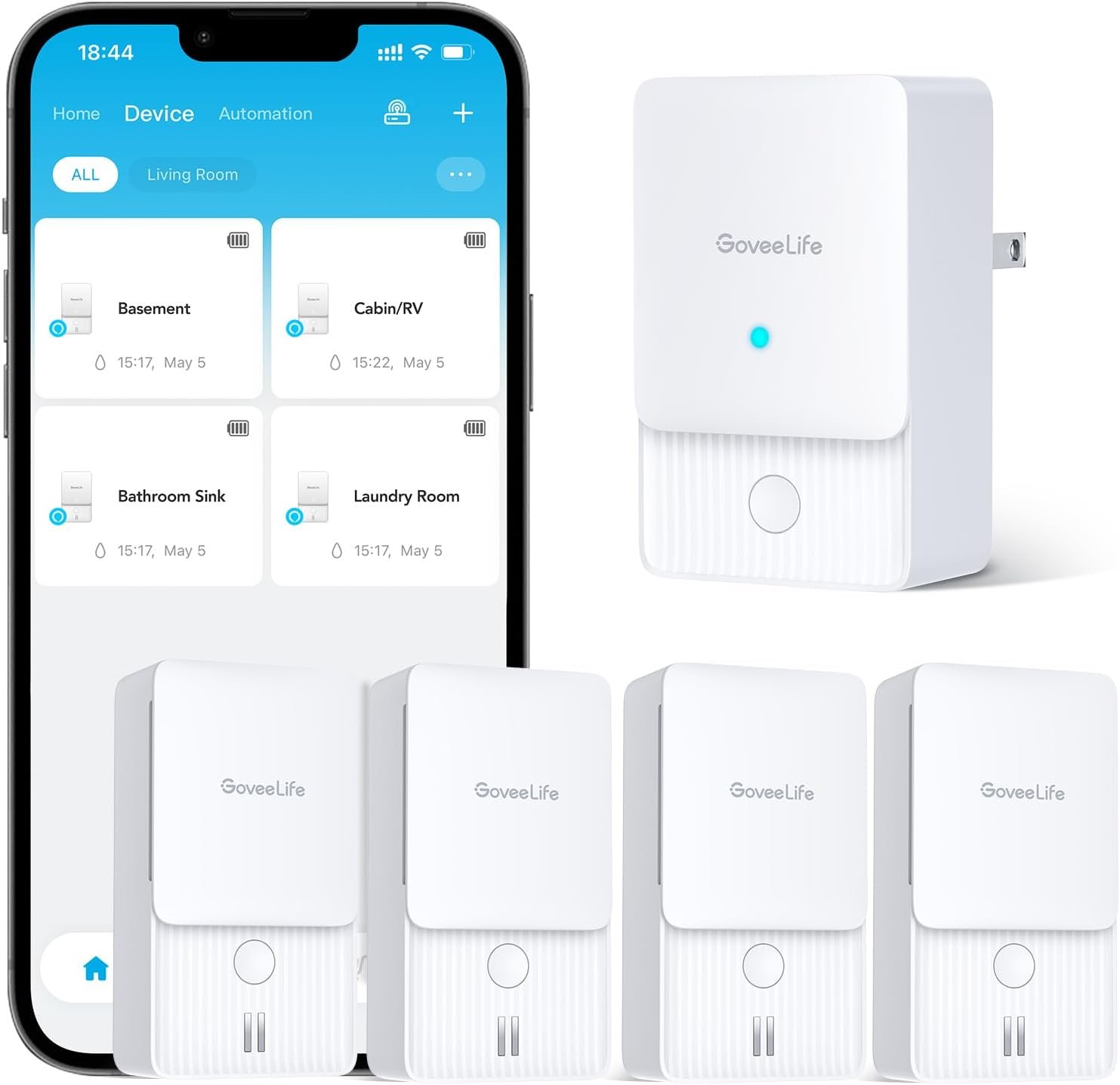
Expert Rating: 4.5/5 Stars | Est. Value: $53.99
In critical infrastructure management, preemptive hazard detection is paramount. Water ingress, often insidious, can devastate sensitive electronics, compromise structural integrity, and lead to prohibitive remediation costs, especially for autonomous or off-grid power systems. The GoveeLife Premium Smart Water Leak Detector 2 offers a technically robust solution for mitigating such risks, providing early warning across expansive deployments.
Core Specifications
- LoRa Connectivity Protocol: The system leverages LoRa (Long Range) technology, enabling an exceptional sensor-to-gateway range of up to 1968 feet (600 meters) in optimal conditions. This extended reach minimizes wireless infrastructure complexity for sprawling properties or multi-building compounds, a critical advantage in distributed off-grid installations where Wi-Fi ubiquity is challenging.
- IP66 Environmental Sealing: Each sensor boasts an IP66 ingress protection rating, certifying it as dust-tight and protected against powerful water jets from any direction. This robust sealing ensures reliable operation in high-humidity environments, basements, utility rooms, or near sumps where direct water exposure is a possibility.
- Autonomous Power Profile: Sensors are rated for a 5-year battery life under normal operational parameters. This longevity significantly reduces maintenance overhead and ensures continuous monitoring without reliance on grid power for extended durations, a key consideration for remote or energy-independent sites.
- Layered Alert Modalities: The system provides multi-channel notifications including SMS, email, and APP push alerts via its 2.4GHz Wi-Fi gateway, supplemented by an integrated 100dB local siren. This redundant notification strategy enhances alert reliability, ensuring stakeholders are informed regardless of network connectivity status or immediate mobile device access.
Real-world Reliability
The GoveeLife system exhibits strong resilience in challenging operational environments. Its LoRa-based sensor communication ensures that leak detection data traverses significant distances, maintaining integrity even if direct Wi-Fi coverage is intermittent or non-existent in remote areas of a property. While the primary gateway relies on 2.4GHz Wi-Fi for cloud-based alerts, the sensors’ 5-year battery life guarantees localized detection and a potent 100dB acoustic alarm, providing critical immediate notification even during grid power outages or primary network failures. The IP66 rating ensures sustained functionality in damp or potentially flooded areas, offering peace of mind under adverse environmental conditions.
Who is this for?
This system is ideal for property managers and off-grid enthusiasts requiring robust, long-range environmental monitoring for critical assets.
Data Breakdown
| Specification | Detail |
|---|---|
| Sensor-Gateway Protocol | LoRa (Long Range) |
| Sensor-Gateway Range | 1968 ft (600m) |
| Gateway Connectivity | 2.4GHz Wi-Fi Only |
| Sensor Battery Life | >5 Years |
| Local Alarm Decibels | 100dB |
| Ingress Protection Rating | IP66 |
| Sensor Probe Configuration | 2 Top, 4 Bottom |
The Tech Advantages:
- LoRa wireless protocol provides an exceptional 1968 ft (600m) sensor-to-gateway range.
- IP66 ingress protection rating ensures durability in harsh, damp environments.
- Outstanding 5-year battery life for sensors, minimizing maintenance.
- Multi-channel notifications: SMS, email, APP push, and a loud 100dB local siren.
- Local detection and siren remain active even during grid power outages.
- Features two top and four bottom sensor probes for comprehensive detection.
The Trade-offs:
- The primary gateway relies on 2.4GHz Wi-Fi for cloud-based alerts, impacting remote notification during internet outages.
- Requires a dedicated GoveeLife gateway for operation.
4. D-Link Next-Gen WiFi Water Leak Detector Starter Kit
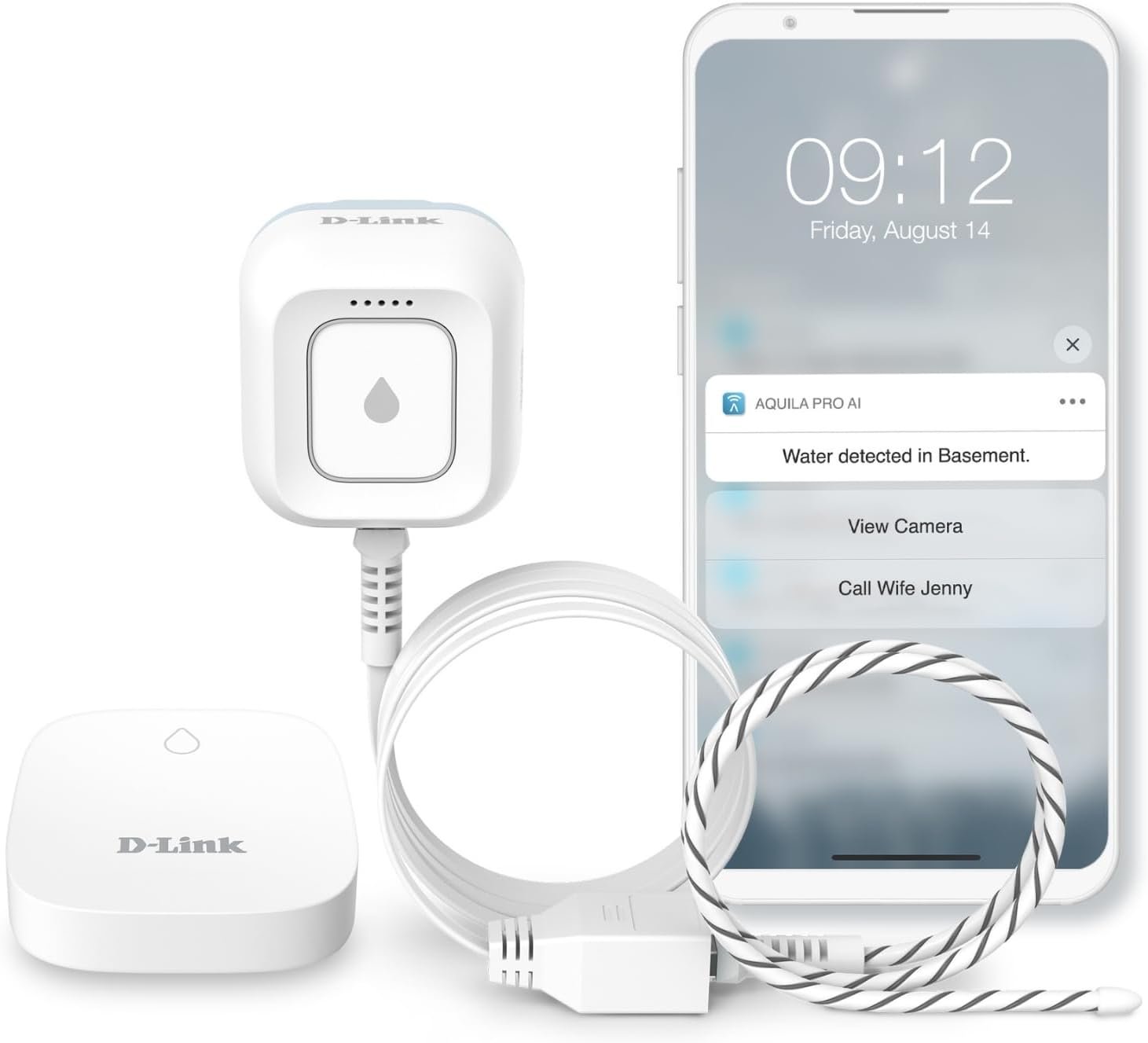
Expert Rating: 4.1/5 Stars | Est. Value: $54.87
Water ingress remains one of the most insidious threats to smart home infrastructure and property integrity, often leading to catastrophic system failures and exorbitant repair costs. For any robust security or off-grid power setup, early detection of environmental hazards like leaks is paramount. The D-Link Next-Gen system aims to provide this critical layer of preemptive defense, protecting vital electrical and structural components.
Core Specifications
- Alert Modalities: This system provides a multi-faceted alert response, featuring a piercing 100 dB integrated siren, a visual LED strobe, and immediate push notifications to a connected mobile device. Further integration allows for vocal announcements via Google Assistant-enabled devices, ensuring critical alerts are conveyed even when other systems might be offline or out of earshot.
- Wireless Connectivity: Leveraging a dual-protocol approach, the system utilizes standard Wi-Fi for primary network communication and a proprietary Sub-GHz radio link for sensor-to-master unit transmission. The Sub-GHz protocol offers superior penetration and an impressive operational range, specified at 300 feet indoors or up to 1000 feet in an unobstructed line of sight. This extends detection capabilities far beyond typical Wi-Fi limitations, crucial for comprehensive property coverage.
- Expandability and Power Autonomy: The starter kit includes a primary plug-in unit and one battery-powered remote pod. The system supports expansion to 17 discrete sensing points using additional SW-A2 pods. These remote pods operate autonomously for up to two years on standard AAA batteries, minimizing maintenance and ensuring sustained functionality during power interruptions to the main unit’s AC supply, provided the network remains active.
Real-world Reliability
While the master unit requires AC power for its siren and Wi-Fi radio, the battery-powered sensing pods maintain independent leak detection capability. In a localized power outage affecting the master unit, the system’s ability to alert via app is compromised, but the pods’ detection hardware remains active. The Sub-GHz link’s robust range mitigates issues with network drops caused by architectural interference, yet a complete Wi-Fi network failure or internet outage would prevent remote notifications, emphasizing the importance of local alert mechanisms like the siren and strobe. Its operation is not directly affected by extreme weather, assuming primary power and network infrastructure remains stable.
Who is this for?
This system is ideal for homeowners or small commercial properties requiring granular water leak monitoring across a large footprint, particularly those with existing Google Assistant ecosystems or where conventional Wi-Fi range is insufficient.
Data Breakdown
| Specification | Detail |
|---|---|
| Alarm Decibel Level | 100 dB (integrated siren) |
| Wireless Protocol (Sensor) | Sub-GHz |
| Wireless Protocol (Network) | Wi-Fi |
| Indoor Wireless Range | 300 ft (Sub-GHz) |
| Open-Space Wireless Range | 1000 ft (Sub-GHz) |
| Max. Expandable Sensors | 17 pods |
| Remote Pod Battery Life | Up to 2 years (AAA) |
The Tech Advantages:
- Multi-faceted alert system: 100 dB siren, LED strobe, push notifications, Google Assistant integration.
- Dual wireless protocol (Wi-Fi + Sub-GHz) for extended range and penetration (300 ft indoors, 1000 ft open-space).
- Expandable to 17 sensing points for comprehensive coverage.
- Remote pods offer up to 2 years of autonomous battery operation (AAA).
- Sub-GHz link mitigates architectural interference for sensors.
The Trade-offs:
- Master unit requires AC power, impacting resilience during grid outages.
- Remote app notifications are contingent on active Wi-Fi and internet connectivity.
- Loss of master unit power compromises the integrated siren and Wi-Fi radio.
5. Kidde WiFi Water Leak Detector
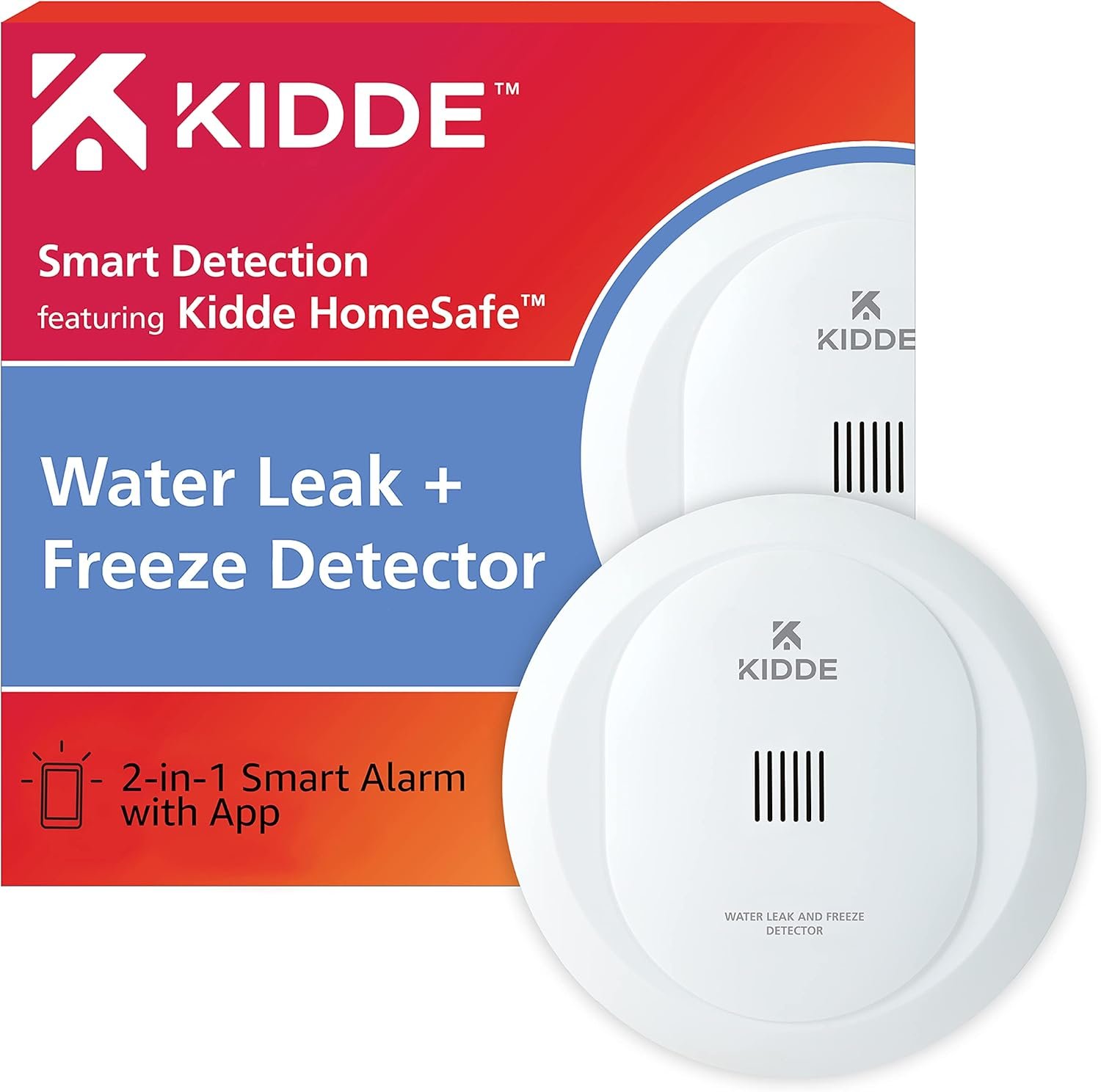
Expert Rating: 4.0/5 Stars | Est. Value: $26.00
Maintaining the integrity of critical home infrastructure is paramount, especially when considering resilience against unexpected events or during periods of grid instability. A robust leak detection system is not merely a convenience; it’s a foundational element of proactive smart home security, safeguarding against catastrophic water damage that can compromise property value and occupant safety.
Core Specifications
- Wireless Protocol (2.4GHz WiFi): This device leverages the 2.4GHz WiFi band for its primary communication, ensuring broad compatibility with existing home networks. However, this choice inherently ties its alerting capability to an active internet connection, bypassing potential benefits of localized, low-power mesh protocols for resilience during network outages.
- Thermal Monitoring Threshold (37°F): Precision in freeze detection is critical. The sensor triggers at a fixed 37°F (2.78°C), providing an explicit, albeit basic, threshold for preventative action against pipe damage. The accompanying “rapid temperature drop” feature, however, lacks defined parameters (e.g., X degrees over Y minutes), making its practical sensitivity and reliability difficult to quantify.
- Power Redundancy (2x AA Batteries): The exclusive use of two AA batteries offers installation flexibility but mandates periodic manual intervention for power maintenance. The absence of an integrated mains power option or a high-capacity rechargeable cell with an estimated cycle life means operational continuity is contingent upon routine, unmonitored battery depletion, potentially introducing downtime.
Real-world Reliability
In scenarios where network stability is compromised, such as during power outages that disable home routers or when broadband connectivity fails, the Kidde detector’s WiFi-exclusive architecture presents a significant vulnerability. Without local audible alarms or a secondary low-power communication protocol (e.g., Z-Wave, Zigbee) to a local hub, alerts are entirely dependent on an active internet connection. This design choice, while simplifying integration, inherently reduces its utility as a standalone security device in off-grid or grid-unstable environments. Its dependence on cloud services also introduces potential points of failure beyond local control.
Who is this for?
This device suits smart home occupants seeking basic, app-notified leak and freeze detection within stable, always-on internet environments.
Data Breakdown
| Specification | Detail | Technical Assessment |
|---|---|---|
| Connectivity | Wi-Fi (2.4 GHz, IEEE 802.11 b/g/n assumed) | Standard RF, broad compatibility; single point of failure (router/ISP) for remote alerts; no local notification. |
| Power Source | 2x AA Batteries (Disposable) | Max. portability; no mains option; manual replacement required; no estimated mAh/Wh capacity provided. |
| Battery Life | Est. 1-2 Years (Usage Dependent) | General industry standard; actual longevity impacted by Wi-Fi activity and environment. |
| Freeze Threshold | 37°F (2.78°C); “rapid temp drop” (parameters undefined) | Fixed, explicit; secondary trigger vague, limits precise risk assessment. |
| Leak Detection | Conductive probe sensors (assumed) | Standard method; highly effective for surface water; no specific sensitivity rating provided. |
| Alert Protocol | Cloud-based push notifications (Kidde App); Smart Home Platform APIs | Relies on external servers and active internet for remote alerts; no integrated local siren. |
| Data Security | Undisclosed (for Wi-Fi communication & cloud data) | Significant omission for a security device; lack of details on encryption protocols (e.g., TLS, AES). |
The Tech Advantages:
- Leverages 2.4GHz WiFi for broad network compatibility.
- Fixed 37°F (2.78°C) thermal monitoring for explicit freeze detection.
- Battery-powered design offers installation flexibility.
- Provides app-based notifications for remote monitoring.
The Trade-offs:
- Alerting capability entirely dependent on active internet and cloud services.
- No integrated local siren or secondary communication protocol (e.g., Z-Wave, Zigbee).
- “Rapid temperature drop” feature lacks defined parameters for reliability assessment.
- Relies on periodic manual battery replacement with no mains power option.
- Undisclosed data security protocols for Wi-Fi communication and cloud data.
Summary Verdict: Spec Comparison
| Image | Product | Rating & Price | Action |
|---|---|---|---|
|
YoLink SpeakerHub | 4.7 Stars $56.98 |
View Specs |
|
Tapo T300 | 4.6 Stars $16.99 |
View Specs |
|
GoveeLife Premium | 4.5 Stars $53.99 |
View Specs |
|
D-Link Next-Gen | 4.1 Stars $54.87 |
View Specs |
|
Kidde WiFi | 4.0 Stars $26.00 |
View Specs |
Essential Technical Factors for Your WiFi Leak Detector Investment
Navigating the burgeoning market of smart home devices requires a keen understanding of underlying technical specifications. For a smart water leak detector with wifi alarm, two factors are paramount to ensure optimal performance and long-term reliability within a secure, independent tech grid:
1. Connectivity Redundancy and Range: Not all “WiFi” leak detectors are created equal. Some units offer direct connection to your home WiFi network, which simplifies setup but introduces a critical single point of failure—if your router loses power or internet connectivity drops, your remote alerts cease. Elite systems often employ a hub-based architecture, where sensors communicate with a central hub using low-power, long-range protocols like LoRa or Sub-GHz. This dramatically extends sensor range, allowing for placement in basements, distant outbuildings, or behind thick walls where standard WiFi struggles. Crucially, assess whether the system provides local audible alarms that function *independently* of WiFi or internet connectivity. This ensures immediate notification even during full grid outages, safeguarding your property’s integrity when it matters most.
2. Environmental Resilience and Integrated Freeze Detection: A leak detector’s ability to withstand and accurately report from its deployment environment is non-negotiable. Prioritize devices with robust IP (Ingress Protection) ratings, such as IP66 or IP67, which denote substantial resistance to dust ingress and temporary water immersion or powerful water jets. This ensures the sensor itself remains operational even in damp, dusty, or potentially flooded areas. Furthermore, for regions susceptible to cold weather, integrated freeze detection is a critical preventative feature. Devices equipped with precise thermistors that trigger alerts when ambient temperatures approach 0°C (32°F) can provide vital early warnings against bursting pipes, preventing extensive water damage before it occurs. This dual-purpose environmental monitoring transforms a reactive leak detector into a proactive resilience tool.