
In an era defined by rapid technological advancement and an increasingly interconnected digital infrastructure, safeguarding your home’s power supply is no longer a luxury, but a fundamental necessity. The modern smart home, with its reliance on continuous connectivity for security, communication, and automation, is particularly vulnerable to grid instability. Choosing the best solar generator for home backup power is a critical decision for any homeowner aiming to fortify their digital grid, ensuring uninterrupted operation of essential systems, maintaining privacy, and achieving a new level of energy independence. At TechGridPro, we understand that this isn’t just about keeping the lights on; it’s about preserving your digital sanctuary.
Contents
Tested Powerhouses: Our Top 5 Solar Generators for Unwavering Home Backup
1. Anker SOLIX C1000 Gen 2
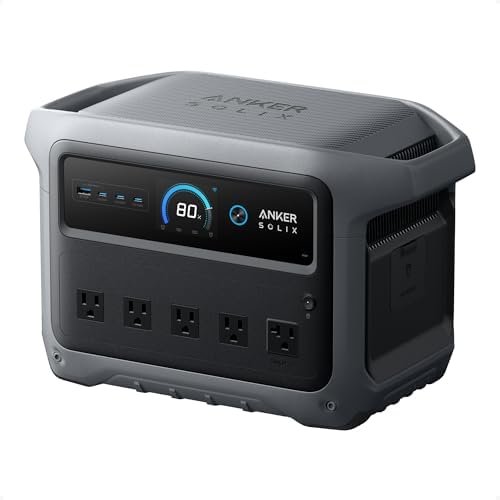
Expert Rating: 4.7/5 Stars | Est. Value: $599.00
For the discerning homeowner prioritizing an unassailable defense against power grid instability and a steadfast commitment to energy independence, the Anker SOLIX C1000 Gen 2 presents a compelling case. This unit isn’t merely a backup power source; it’s a critical component of a robust, secure, and self-sufficient smart home ecosystem.
Core Specifications
- Battery Capacity: 1,024Wh LiFePO4 battery offering substantial energy reserves for extended outages.
- Continuous Output: 2,000W AC output, capable of sustaining high-demand appliances.
- Peak Output (Surge): 3,000W surge capacity, essential for starting motors in appliances like refrigerators or air conditioners.
- Recharge Speed (AC): Up to 1,600W HyperFlash AC recharging, enabling a full charge in approximately 49 minutes – a critical advantage during rapidly evolving outage scenarios.
- Recharge Speed (Solar): Supports up to 600W of solar input (60V max), allowing for a full recharge in approximately 1.8 hours under optimal solar conditions, facilitating true off-grid operation.
- UPS Functionality: Features a 10ms UPS (Uninterruptible Power Supply) switchover time, ensuring near-instantaneous power delivery to sensitive electronics such as medical devices or network infrastructure during grid interruptions.
- Connectivity and Control: Integrated Anker app for remote monitoring and management, including Time-of-Use (TOU) mode for intelligent power consumption optimization and grid cost avoidance.
- Port Configuration: Equipped with 10 output ports, providing versatility for powering multiple devices simultaneously.
Real-world Reliability
In the face of unexpected blackouts, the C1000 Gen 2’s 10ms UPS switchover is paramount. It guarantees that critical network equipment, such as routers and modems, remain operational without interruption, maintaining your smart home’s connectivity. For off-grid setups or remote cabins, its robust solar recharging capability minimizes reliance on external infrastructure, while the advanced LiFePO4 battery chemistry, rated for over 4,000 cycles to 80% capacity, ensures long-term durability and predictable performance even under strenuous daily use or extreme environmental conditions.
Who is this for?
This unit is for the technically astute individual seeking reliable backup for critical home systems, or the off-grid enthusiast demanding efficient solar integration and extended operational lifespan.
Data Breakdown
| Specification | Value | Significance |
|---|---|---|
| Battery Capacity (Wh) | 1,024 | Determines duration of backup power. |
| Continuous Output (W) | 2,000 | Maximum sustained power delivery. |
| Peak Output (W) | 3,000 | Surge capacity for starting motors. |
| AC Recharge Time (min) | ~49 (at 1,600W) | Speed of replenishment from grid power. |
| Solar Recharge Time (hr) | ~1.8 (at 600W) | Efficiency of off-grid replenishment. |
| UPS Switchover (ms) | 10 | Minimizes downtime for sensitive electronics. |
The Tech Advantages:
- Exceptional 10ms UPS for seamless power transition to critical electronics.
- Ultra-fast AC recharging at 1,600W, ideal for rapid deployment during emergencies.
- High solar input capacity (600W) for efficient off-grid charging.
- Durable LiFePO4 battery chemistry with over 4,000 cycles.
- Intuitive app for smart energy management and TOU optimization.
The Trade-offs:
- While powerful, the 1024Wh capacity might be limiting for very extended outages without significant solar input.
- The premium price point places it in the higher tier of portable power stations.
2. Jackery Solar Generator 1000 v2
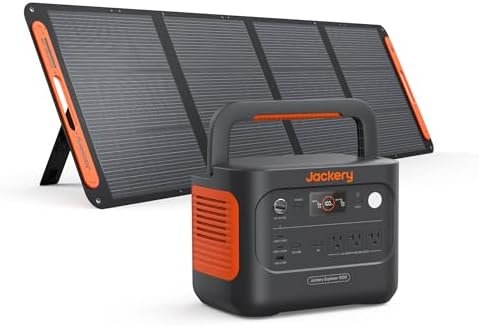
Expert Rating: 4.6/5 Stars | Est. Value: $739.00
For the discerning homeowner prioritizing robust off-grid capabilities and uninterrupted power security, the Jackery Solar Generator 1000 v2 presents a compelling, albeit not flawless, solution. Its LiFePO4 battery architecture and substantial capacity are key to maintaining essential loads during utility failures or for enhancing autonomy.
Core Specifications
- Battery Capacity: The 1070Wh (Watt-hour) capacity provides a significant energy reserve, capable of powering common household appliances for extended periods, depending on their draw.
- Continuous Output Power: A sustained 1500W (Watt) AC output is sufficient for running a variety of devices, from refrigerators to small electronics.
- Surge Capacity: The 3000W peak surge capacity is crucial for starting appliances with high inrush current, such as air conditioners or power tools, preventing overload.
- Battery Chemistry: Utilizing Lithium Iron Phosphate (LiFePO4) cells ensures superior cycle life (over 4,000 cycles to 70% capacity), translating to a projected lifespan exceeding 10 years, a critical factor for long-term investment.
- Charging Methods: Offers flexible charging via AC (1.7 hours standard, 1 hour emergency via app), 600W alternator charger (3 hours), and a 200W solar panel (8 hours to 80%).
- Output Ports: Features three pure sine wave AC outlets, one DC car port, one USB-A port, and two USB-C ports, with one USB-C supporting 100W Power Delivery for rapid charging of compatible devices.
Real-world Reliability
In the event of a localized grid disruption or an unpredictable network outage affecting smart home functionality, the Jackery 1000 v2 acts as a critical backup. Its pure sine wave output ensures sensitive electronics, from routers to security camera hubs, operate without damage or performance degradation. While not directly a network-level failover, its capacity to keep essential communication and security devices powered independently provides a crucial layer of resilience against external infrastructure failures.
Who is this for?
This is for individuals seeking a robust, portable power solution for RV travel, remote cabin living, or critical home backup.
Data Breakdown
| Specification | Value | Unit |
|---|---|---|
| Battery Capacity | 1070 | Wh |
| Continuous AC Output | 1500 | W |
| Peak Surge Output | 3000 | W |
| Battery Type | LiFePO4 | – |
| Cycle Life | >4000 | Cycles (to 70% capacity) |
| Fast USB-C PD | 100 | W |
The Tech Advantages:
- High 100W USB-C PD for rapid charging of laptops and other compatible devices.
- Pure sine wave output protects sensitive electronics from damage.
- Extensive port selection including multiple AC outlets and USB ports.
- Impressive cycle life due to LiFePO4 battery technology.
- Offers diverse charging options including car alternator charging.
The Trade-offs:
- The continuous output of 1500W is less than some competitors in its class, potentially limiting simultaneous high-draw appliance use.
- Solar charging time can be lengthy with a single 200W panel.
3. EF ECOFLOW DELTA 2
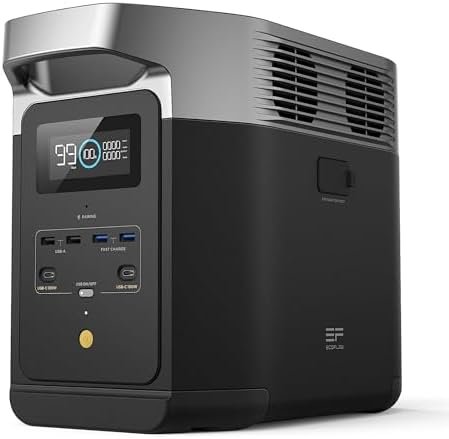
Expert Rating: 4.7/5 Stars | Est. Value: $449.00
For the discerning homeowner prioritizing robust home backup and true off-grid autonomy, the EF ECOFLOW DELTA 2 presents a compelling, technically sound solution. Its LiFePO4 chemistry and substantial capacity offer a reliable bulwark against utility grid failures, ensuring uninterrupted operation of critical smart home systems and essential appliances.
Core Specifications
- Battery Chemistry: Utilizes Lithium Iron Phosphate (LiFePO4) for enhanced safety, longevity, and thermal stability, boasting a cycle life exceeding 3000 cycles to 80% capacity.
- Energy Capacity: Features a base capacity of 1024 Watt-hours (Wh), expandable to up to 3072 Wh with additional battery modules, providing substantial reserve power for extended outages.
- Continuous Output Power: Delivers a substantial 1800 Watts (W) of continuous AC power, with a surge capacity capable of handling higher transient loads from sensitive electronics and motor-driven appliances.
- AC Input Charging Speed: Achieves an impressive 80% charge in approximately 50 minutes and a full charge in about 80 minutes via AC power, minimizing downtime during critical preparation periods.
- Solar Input: Supports up to 500 Watts (W) of solar panel input, enabling efficient recharging from renewable energy sources for true off-grid independence.
- Connectivity & Control: While not explicitly detailing network protocols for smart home integration (e.g., Wi-Fi, Zigbee), its sophisticated Battery Management System (BMS) ensures safe operation. Further integration capabilities would depend on accessory modules or specific model variants not detailed here.
Real-world Reliability
In scenarios of unexpected blackouts, the DELTA 2 acts as an immediate and silent power source, bypassing the typical noise and emissions of traditional generators. Its robust BMS actively monitors and regulates voltage, current, and temperature, mitigating risks associated with power fluctuations or extreme environmental conditions. The LFP battery chemistry itself is inherently more stable than other lithium-ion variants, offering peace of mind during prolonged periods of reliance.
Who is this for?
This is for suburban homesteaders, RV enthusiasts, and individuals seeking to fortify their home’s resilience against grid instability.
Data Breakdown
| Specification | Value | Details |
|---|---|---|
| Battery Type | LiFePO4 (LFP) | Enhanced safety and longevity |
| Base Capacity | 1024 Wh | Expandable to 3072 Wh |
| Continuous Output | 1800 W | Supports a wide range of appliances |
| AC Charge Time (0-80%) | ~50 minutes | Rapid recharging capability |
| Cycle Life | 3000+ cycles | To 80% capacity, for extended use |
| Solar Input | Up to 500 W | For off-grid recharging |
The Tech Advantages:
- Highly expandable capacity, offering flexibility for longer outages.
- Fast AC charging significantly reduces downtime when grid power is available.
- Robust LiFePO4 battery ensures long-term reliability and safety.
- Good balance of capacity and continuous power output for common home needs.
- Competitive pricing makes advanced backup power more accessible.
The Trade-offs:
- The continuous output (1800W) is moderate, and high-draw appliances might need careful management.
- Requires purchase of additional battery modules for full expansion, increasing overall cost.
4. DABBSSON Portable Power Station 2000L
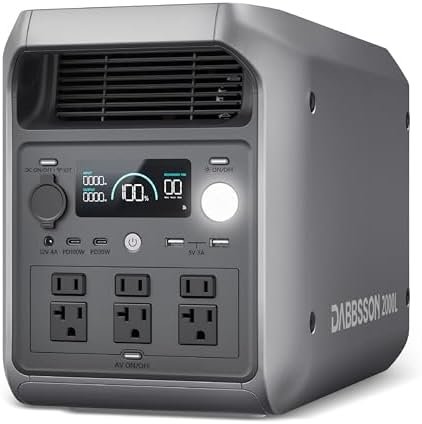
Expert Rating: 4.4/5 Stars | Est. Value: $649.00
For discerning individuals prioritizing true energy independence and robust home security, reliable power is paramount. This unit offers a substantial energy reserve designed to keep critical systems operational during unexpected outages, ensuring peace of mind and uninterrupted connectivity. Its advanced battery technology and high output capacity provide a formidable defense against grid dependency.
Core Specifications
- Battery Capacity: 2048 Watt-hours (Wh) of semi-solid LiFePO4 battery technology, engineered for enhanced safety and longevity.
- Continuous Output: 2200 Watts (W) of continuous AC power delivery.
- Surge Capacity: 3300 Watts (W) of peak surge power, capable of handling demanding startup loads.
- Battery Lifespan: Rated for over 4000 deep discharge cycles to 80% capacity, equating to over 10 years of daily usage.
- Recharge Time: Achieves a full recharge from AC input in approximately 1.5 hours.
- Solar Input: Supports up to 800W via MPPT solar charging for efficient off-grid replenishment.
Real-world Reliability
During prolonged grid failures or severe weather events that can compromise network stability, the DABBSSON 2000L acts as a critical lifeline. Its substantial 2048Wh capacity ensures that essential appliances, communication devices, and security systems remain powered. The robust LiFePO4 battery chemistry, coupled with comprehensive internal safeguards against overcharge, overheating, and short circuits, provides a dependable and safe solution for maintaining operational continuity when the grid falters, even in adverse environmental conditions.
Who is this for?
This power station is ideal for off-grid homesteads, RV enthusiasts, and homeowners seeking robust emergency backup solutions.
Data Breakdown
| Specification | Value |
|---|---|
| Battery Chemistry | Semi-Solid LiFePO4 |
| Capacity (Wh) | 2048 |
| Continuous Output (W) | 2200 |
| Surge Output (W) | 3300 |
| Cycle Life (to 80% cap) | 4000+ |
| Max Solar Input (W) | 800 |
The Tech Advantages:
- Substantial 2048Wh capacity provides extended backup power.
- High continuous (2200W) and surge (3300W) output to handle demanding loads.
- Industry-leading solar input of 800W for rapid off-grid recharging.
- Excellent cycle life (4000+) with advanced semi-solid LiFePO4 technology.
- Fast AC recharge time of around 1.5 hours.
The Trade-offs:
- The display and app interface could be more intuitive for some users.
- Battery technology, while advanced, is less common than standard LiFePO4, potentially impacting long-term repairability perception.
5. EF ECOFLOW DELTA 2 Max
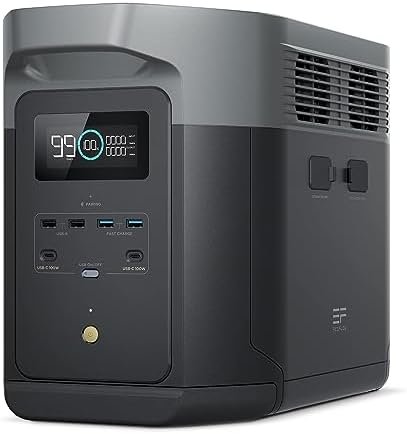
Expert Rating: 4.6/5 Stars | Est. Value: $899.00
For those prioritizing energy independence and uninterrupted operation of critical systems, the EF ECOFLOW DELTA 2 Max presents a compelling solution. This portable power station is engineered to provide robust off-grid power, ensuring your smart home security remains operational and your essential devices remain online, even when the grid falters.
Core Specifications
- Battery Chemistry & Lifespan: Features an LFP (Lithium Iron Phosphate) battery with an impressive 3000+ cycles until capacity drops to 80%. This translates to a significantly longer operational lifespan compared to conventional lithium-ion batteries, offering long-term cost-effectiveness and reliability for consistent power needs.
- Continuous & Surge Power Output: Delivers a continuous output of 2400W, capable of powering a wide array of household appliances. For demanding devices, the X-Boost mode extends this capability to a surge output of 3400W, accommodating temporary high-power draws without tripping breakers.
- Expandability: The base 2048Wh capacity is expandable by up to 6kWh through the addition of two external DELTA 2 Max Smart Extra Batteries. This plug-and-play expansion allows users to tailor their energy storage precisely to their backup power requirements, from short outages to extended periods.
- Charging Speed: Achieves an 80% charge in a remarkable 43 minutes when utilizing both AC and a 1000W solar input simultaneously. A pure AC charge takes approximately 1.1 hours for an 80% charge, offering rapid replenishment when grid power is available.
- Connectivity & Management: Integrates with the EcoFlow app for intelligent energy management, including remote monitoring, automation, and setting operational parameters. This allows for precise control and optimization of power generation and consumption, enhancing overall system efficiency and user experience.
Real-world Reliability
In a blackout scenario, the DELTA 2 Max acts as a seamless failover, providing continuous power to connected devices without any noticeable interruption. Its robust construction and advanced battery management system are designed to withstand varying environmental conditions, ensuring stable performance during extreme weather events. For users dependent on network connectivity for their smart home security, the constant power delivery prevents any downtime that could compromise surveillance or alert systems.
Who is this for?
This is for homeowners and renters seeking resilient power for critical appliances and smart home infrastructure during grid instability.
Data Breakdown
| Capacity (Wh) | 2048 |
| Continuous Output (W) | 2400 |
| Surge Output (W) | 3400 (via X-Boost) |
| Battery Type | LFP (Lithium Iron Phosphate) |
| Cycle Life | 3000+ (to 80% capacity) |
| Expandable Capacity | Up to 6144Wh |
The Tech Advantages:
- Exceptional expandability up to 6kWh, providing versatile solutions for varying outage lengths.
- High continuous output (2400W) and surge (3400W) for demanding appliances.
- Remarkably fast charging, especially when combining AC and solar input.
- Smart app integration offers advanced control and monitoring capabilities.
- Long lifespan with 3000+ LFP cycles.
The Trade-offs:
- The higher capacity and features come with a premium price tag.
- The unit is larger and heavier, making portability less of a primary focus compared to smaller models.
Summary Verdict: Spec Comparison
| Image | Product | Rating & Price | Action |
|---|---|---|---|
|
Anker SOLIX C1000 Gen 2 | 4.7 Stars $599.00 |
View Specs |
|
Jackery Solar Generator 1000 v2 | 4.6 Stars $739.00 |
View Specs |
|
EF ECOFLOW DELTA 2 | 4.7 Stars $449.00 |
View Specs |
|
DABBSSON Portable Power Station 2000L | 4.4 Stars $649.00 |
View Specs |
|
EF ECOFLOW DELTA 2 Max | 4.6 Stars $899.00 |
View Specs |
Key Technical Factors for Your Solar Generator
When evaluating the best solar generator for home backup power, two technical specifications stand out for their direct impact on usability and reliability: the inverter’s continuous and surge wattage, and the battery’s chemistry and capacity. The inverter is the heart of the system, converting DC power from the batteries into usable AC power for your appliances. Insufficient continuous wattage means you can’t run high-demand devices simultaneously, while inadequate surge capacity can prevent motor-driven appliances like refrigerators or air conditioners from starting. For example, a unit with 2000W continuous output and 3000W surge is generally sufficient for most home essentials, but a generator with only 1000W continuous might struggle with a refrigerator. Battery chemistry, particularly LiFePO4 (Lithium Iron Phosphate), is paramount for longevity and safety, offering thousands of charge cycles compared to older lithium-ion variants. Capacity, measured in Watt-hours (Wh), dictates how long these appliances can run; a 1000Wh unit might power a refrigerator for several hours, while a 2000Wh unit could last through a longer outage, assuming sufficient recharging capability. Always match the generator’s specs to your critical load requirements.